

Beta Available for BigQuery projects only and enabled per organization; ask Lightdash support to turn it on. What Beta means.
STRUCT (RECORD) or a repeated ARRAY of scalars or structs. Define their leaves with dotted column names in dbt YAML. Lightdash keeps non-repeated leaves on the model and exposes repeated columns as virtual tables joined with UNNEST.
Use How column shapes map to fields for a visual overview and Define nested columns in YAML for the complete configuration. Refer to Virtual tables, Query behavior and grain, Query warnings, Pre-aggregates, and Known limitations as needed.
How column shapes map to fields
Non-repeated STRUCT (RECORD)
A leaf below a non-repeated struct is an ordinary dimension on the model with its dotted name. In thisorders model, - name: customer.address.city exposes only the city leaf. Add separate entries for customer_id, name, or street if you also want them as fields.
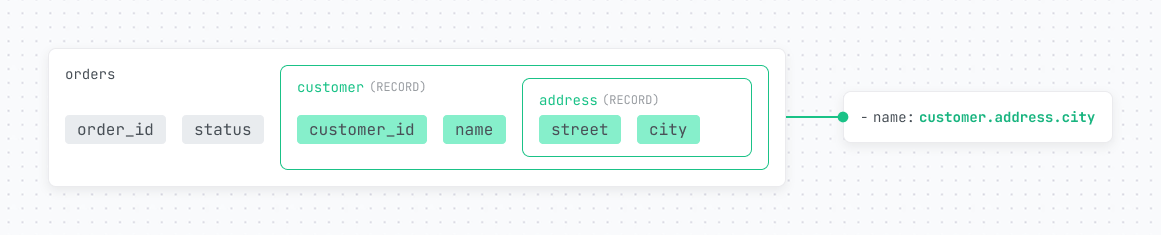
customer.address.city dimension compiles to `orders`.customer.address.city and has the field ID orders_customer__address__city. Lightdash gets its type from the warehouse catalog, so meta.dimension.type is optional. An explicitly declared type takes precedence over the catalog type.
REPEATED (ARRAY)
A repeated column with at least one listed leaf becomes a virtual table. In thisorders model, line_items.sku becomes the sku dimension on orders__line_items. The price leaf is not exposed because it is not listed in YAML.
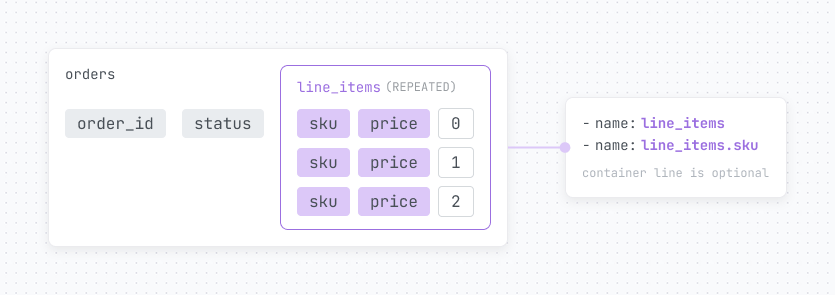
- name: line_items container entry is optional. Include it when you want to set the virtual table’s description or meta.dimension.label. Every virtual table also gets an offset dimension for the array position, so this example exposes sku and offset on orders__line_items.
Define nested columns in YAML
Add one YAML entry for each leaf you want to expose. Use a dotted path that matches dbt-bigquery’s column naming convention. Lightdash reads the warehouse catalog to determine whether each node in the path is a struct or an array; the YAML does not declare the container type. Only leaves listed in YAML become fields. The diagrams above use a smallorders model; the complete example below uses the public bigquery-public-data.google_analytics_sample.ga_sessions_20170801 table to show a repeated record nested inside another repeated record. The table has one row per session:
lightdash generate does not write container entries or entries below a repeated column, so add those entries by hand.
Virtual tables
Each repeated column with at least one leaf listed in YAML becomes a virtual table in the Explore view. The virtual table is joined withUNNEST, and its leaves become the table’s dimensions and metrics.
A leaf belongs to the virtual table of its deepest repeated ancestor. For example, hits.page.pagePath becomes the page.pagePath dimension on ga_sessions__hits. There is no nesting-depth limit: a repeated column inside another repeated column creates a chain of virtual tables.
Names and field references
- Table name:
<model>__<column>. Nested virtual-table names continue the chain, as inga_sessions__hits__product. The separator is two underscores. - Sidebar label:
<Model label>: <Column label>. A nested label continues the chain, as inGa sessions: Hits: Product. - Field ID:
<virtual table>_<dimension>, as inga_sessions__hits__product_v2ProductName. - YAML reference: use the virtual-table name as the table prefix. For example, use
${ga_sessions__hits__product.productRevenue}in metric SQL andga_sessions__hits__product.v2ProductNamein filters and pre-aggregates.
offset, which is the element’s zero-based position in its array.
If a generated virtual-table name clashes with any other table in the Explore, that Explore fails to compile and the error names the conflicting table.
Join behavior
Lightdash joins a virtual table with a left join andON TRUE. The relationship is one-to-many, so a parent with an empty or NULL array keeps its row with NULL leaf values. A virtual table has no primary key and cannot declare one; its grain is the parent row multiplied by the array element.
When a model is joined into another Explore under an alias, or joined more than once, its virtual-table names and labels follow that alias. For example, aliases named billing_customer and shipping_customer produce billing_customer__addresses and shipping_customer__addresses.
Generated SQL
For a query that selectsga_sessions.date, hits.product.v2ProductName, and the sum of hits.product.productRevenue, Lightdash generates two chained UNNEST joins:
Query behavior and grain
The query grain follows the fields included in the query:- A virtual table is joined only when one of its fields is selected, filtered, or sorted, just like any other joined table. If the query uses no repeated leaf, Lightdash does not add
UNNEST, and the query stays at the model’s grain. - When the query uses a repeated leaf, the result has one row per array element.
- Metrics defined on the model pass through Lightdash’s existing primary-key deduplication. They remain correct at element grain when the model declares a
primary_key. - Metrics defined on a repeated leaf are calculated at element grain.
- A filter on a repeated leaf is row-level and keeps only matching elements. It does not filter parents by whether any element matches.
- Grand totals in the results table drop dimensions. If a query’s only repeated fields are dimensions, its grand total is calculated at model grain.
Query warnings
The yellow icon next to Run query shows warnings about combinations that can inflate metrics.-
When two repeated columns that are not nested inside one another are selected together, Lightdash shows this warning once per query and only for the deepest virtual tables. A chain such as
hitsandhits.productdoes not trigger it:Repeated columns “ga_sessions__hits” and “ga_sessions__customDimensions” are unnested together, so each row pairs their elements and metrics can be inflated.
-
When a metric on a virtual table is queried with a deeper or sibling unnest, Lightdash shows:
Metric “Hit count” could be inflated by another unnested repeated column.
-
The existing could be inflated due to join relationships warning still applies to model metrics that Lightdash cannot deduplicate, including metrics on a model without a
primary_key.
Pre-aggregates
Reference virtual-table fields with the virtual-table name as their table prefix:Deploy and generate
Explores compile in the CLI duringlightdash deploy, and the CLI reads the nested-column setting from the Lightdash server. Use a CLI release that contains PR #28718 or later. An older CLI, or a CLI that cannot reach the server, compiles with nested-column support disabled and silently drops repeated leaves from the Explore.
On self-hosted deployments, add unnest-repeated-columns to LIGHTDASH_ENABLE_FEATURE_FLAGS; see Feature flags.
lightdash generate does not generate an entry for a container column or any leaf below a repeated column. Add those entries to the generated YAML by hand.
Known limitations
- Only BigQuery is supported. On another warehouse, the model fails to compile with an error that names the warehouse.
- Pre-aggregates have a correctness limitation for model metrics at a coarser grain.
- There is no parent-level containment filter, such as “sessions that contain product X,” that preserves the parent grain.
- You cannot access an element by index without unnesting, such as
hits[0].page.pagePath. Define a dimension with customsqlinstead. - Selecting the struct or array container itself is not supported. Its cell displays JSON text, and CSV or Excel exports display
[object Object]. Support for the underlying-data view on tables with nested columns is tracked as PROD-483. - Selecting two repeated columns that are not nested inside one another multiplies their rows. See Query warnings.
- SQL Runner and virtual views type nested columns but do not expand them.